
DYK # 39: Did you know… you're sabotaging your own VoC programme!
The first Voice of Customer (VoC) presentation I ever created was titled: What is VoC and Why is it important? That’s about 10’ish years ago now.
It sounds like a simple topic, but little did I know how much confusion we were facing in the field of Customer Experience (CX), and VoC, and how much is still unclear and misunderstood today.
What I didn’t realise back then, was that most people think of VoC as surveys. And most organisations thought it was enough to create reports, sharing monthly NPS numbers with the board. And voila, you were customer centric.
“Surprisingly”, that didn’t actually work. Yet, we’re still doing the same things. So what’s the problem? Is VoC not an effective tool? Are customer insights not valuable?
No. The challenge isn’t that VoC programmes or customer insights aren’t useful. The challenge is that we’re not doing it right. The way forward is clear, but many organisations get stuck along the way.
Let’s unpack this.
Starting at the beginning: What is VoC?
In a nutshell, a Voice of Customer (VoC) programme is centred around the idea that we (organisations) need to listen to our customers, to understand what’s working for them, and where our improvement opportunities lie, so we can drive business growth.
The easiest way to explain this is via the Insights to Action framework. Check out our DYK # 5, explaining the Insights to Action framework in more detail.
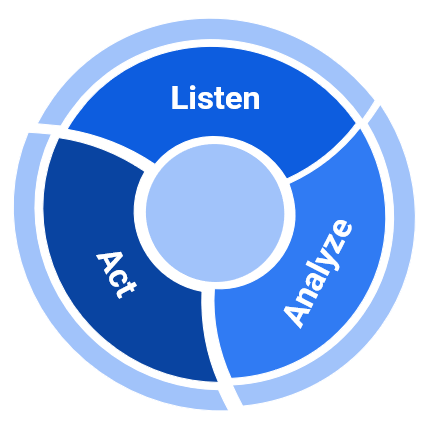
3 Phases:
Listen - Analyse - Act.
Sounds simple enough. But it’s not, as we’ll see in a moment.
Super quick summary:
Listen: You listen to customers via “feedback”.
Analyse: You analyse that data to create insights.
Act: You act on those insights to improve the customer experience and drive business performance.
So what’s the problem?
Every phase brings with it unique challenges.
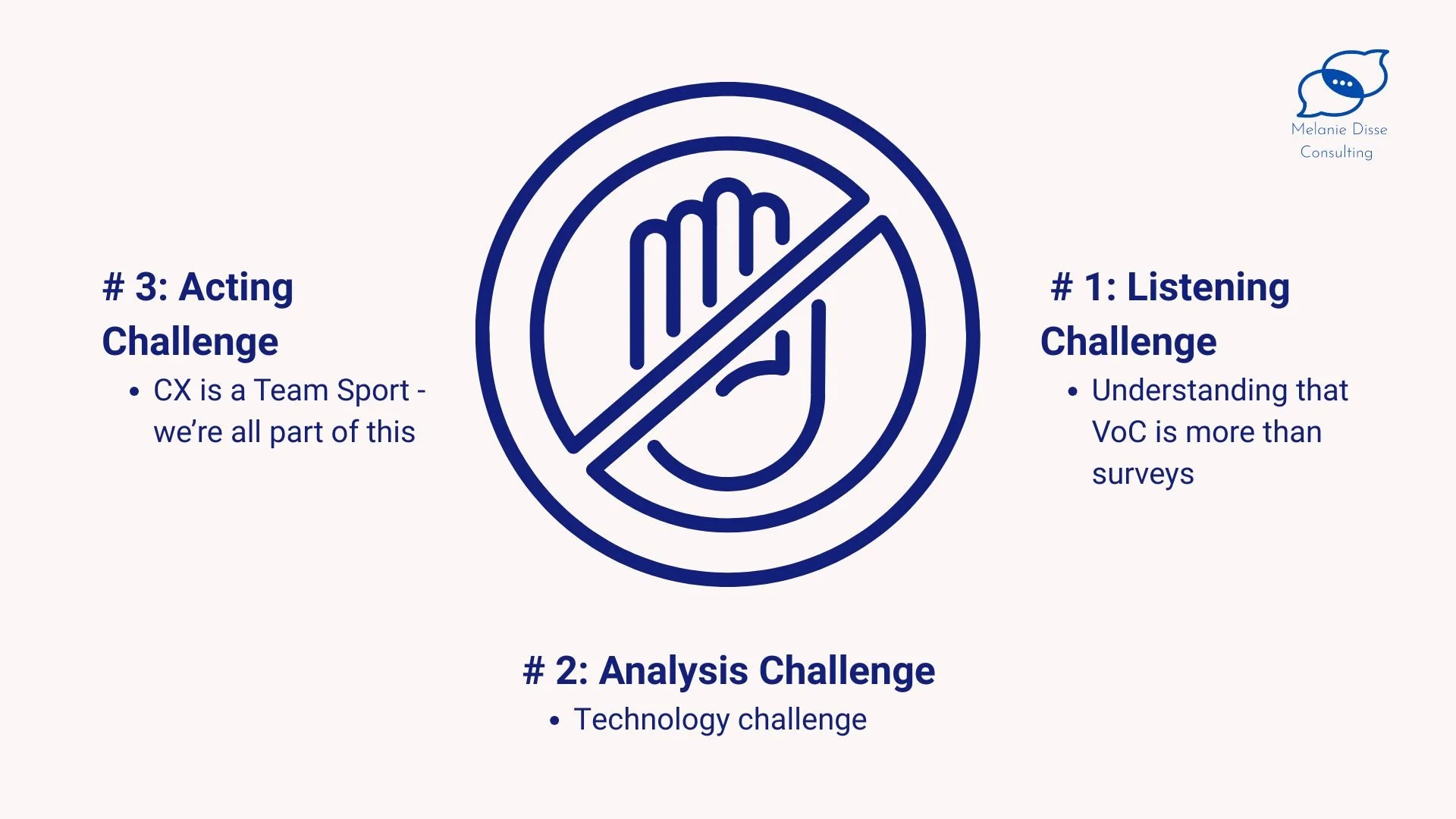
1. Listening challenge: Understanding that VoC is more than surveys
For most people, VoC simply means surveys. And if your organisation has a very traditional VoC program, you might be purely focusing on surveys.
These days, however, feedback comes from many more sources than surveys alone. The contact center has quickly emerged as a treasure trove of customer insights, and a lot of rich insights sits in other unsolicited data such as social media, online reviews, tickets, etc.
When I ventured into the world of VoC many moons ago, I came with a background as a tech analyst. So very early on, I wondered why we purely rely on surveys, when the contact center is full of feedback! Unsolicited and unstructured feedback, but raw customer feedback nonetheless. Since then, online reviews, social media, tickets, etc. joined the data sources we can explore to extract insights from.
While vendors and consultants (like myself) shout it from the rooftops “VoC is more than just surveys and metrics, you need to truly listen to your customers”, many organisations are still running traditional survey based programs.
So why are so many organisations still largely relying on surveys alone?
It makes sense that that’s where VoC started, given that 10 -15 years ago, the only (viable) way for us to know what customers thought of us (our organisations, brand, products, services, etc.) was to go out and ask. But why haven’t we evolved?
Lack of knowledge or understanding that VoC doesn't equal surveys seems one of the key challenges. While consultants and vendors shout it from the rooftops that "listening" has evolved beyond survey, many organisations are still in that traditional mindset. Large enterprises, in particular, pivot slowly, and changing their beloved NPS program (often tied to incentives or KPIs) takes time or is too scary to attempt.
So challenge # 1 is a listening challenge: Lack of understanding and clarity that "feedback" comes from many more sources than surveys alone.
If you managed to tackle this challenge in your organisations, you may be finding yourself facing challenge # 2.
2. Analyse: Tech challenge
If you’re broadening your VoC feedback sources to include other sources, often unsolicited and unstructured in nature, you need different tech to help you analyse that feedback. Traditional survey tools often struggle analysing unstructured data, let alone unifying data across data types and sources.
With insights now coming from the contact centre as well, the technology to use for analysis, may actually sit within your Contact Centre, and not your Insights or CX team. Which brings with it some more challenges, and instead of unifying data, you may end up with more silos.
The good news is, the tech now exists to help us analyse and unify all that raw, and often unsolicited and unstructured data across all sources. The challenge for organisations now is multifold:
Knowing which tech to use and when (DYK # 33)
Enabling data sharing - break down those mental silos alongside data and technology silos (data living in tools or dashboards, or worse still, is held captive with specific teams unwilling to share “their customer data”)
Changing a tech stack and securing a budget isn’t always easy and can seem scary
Low levels of trust in AI - this one is a big one and rather topical
AI (GenAI and the LLMs) have played a vital role in enabling us to make sense of all that unstructured data. The tech is here now, readily available, but trust is still low. For good reason at times, as examples of rouge AI bots or hallucinating analytics engines become more frequent. It doesn’t mean you shouldn’t use AI at all. It means you need to choose carefully, and test and learn what works for you.
If challenge 1 and 2 aren’t enough already (or you managed to tackle those), you may find yourself facing challenge # 3. And this one is often an underlying challenge people don’t realise.
3. Acting challenge: CX is a Team Sport
When I started working in VoC, I thought tech was the problem that’s holding us back. Analysing unstructured data was hard, slow and expensive. Fast forward to today, and we have the tech! It’s fast, easily available, and easy to use.
The challenge most, if not all organisations face, is how to act on the feedback. And that’s hard, because we need EVERYONE in the organisation to be part of this.
Customer Experience is a Team Sport.
So what does acting on feedback look like and why do we need all teams across an organisation to be part of this? (And just to be clear, creating reports does not count as “acting on feedback”.)
It means we drive change based on the insights we have. That can happen in 3 different ways:
Regardless of how we move insights into action, the underlying challenge is that CX is a collective effort (or a Team Sport).
Every single team within an organisation (most anyway) have a direct or indirect impact on the experiences customers have with your organisation. However, there's often a disconnect between the teams that hear about customer pain points and the teams that are responsible for it.
Just because the Contact Center or Insights teams are the ones who hear about the experiences customers have, and hold the insights, doesn’t mean they are the ones who:
Broke the experience in the first place, and
Are responsible (or capable) of fixing it
Insights not only need to be democratised so the right people have access to them, we also need to build a culture of customer centricity, where everyone is held accountable for their part in the customer journey.
If you’re interested in learning more about how to build that for your organisation, stay tuned as we’ll release more information on our concept of CXTS - CX is a Team Sport (and how to build a winning CX practice for your organisation).
If those challenges sound familiar, let’s chat. We can help you on all 3 fronts.
Bonus:
If you’d like a practical deep dive, we’re offering Lunch & Learn sessions on this topic, including how to navigate the changing VoC landscape, evolving tech, and organisational silos. So get in touch for a chat.
If the concept that CX is a Team Sport resonates with you, sign up for our upcoming book “Customer Experience is a Team Sport”, available later in 2026.
#CX #Customerexperience #CXTS #VoC #customerfeedback #customerinsights #technology #AI